Sleigh Christmas Decoration Ornament: A Comprehensive Evaluation
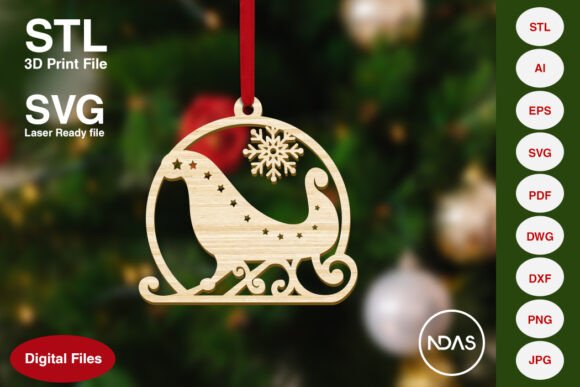
The Sleigh Christmas Decoration Ornament represents a specific category of holiday decor that blends traditional festive imagery with modern digital fabrication capabilities. Unlike mass-produced ornaments found in retail stores, this item is typically defined by its availability as a set of digital design files. These files are engineered to allow users to create their own versions of the sleigh and Santa Claus motif using various materials and manufacturing methods. The core value proposition lies not in the physical object itself, but in the versatility provided by the source code for production.
Understanding the Digital Asset
At its foundation, this product is a collection of technical drawings rather than a tangible good. The package usually includes multiple file formats designed for different software ecosystems and hardware requirements. For those engaged in 3D modeling, the inclusion of an STL file allows for additive manufacturing via 3D printers. Simultaneously, creators utilizing subtractive manufacturing or cutting tools have access to vector-based formats such as SVG, EPS, DXF, DWG, and AI files. Additionally, raster images like PNG and JPG provide options for simple printing or visual reference.
The dimensions provided for this design are approximately 5.5 inches in width and 3.8 inches in height. In a three-dimensional context, the depth is noted at roughly 0.25 inches. It is important to note that these measurements serve as a baseline. The scalability of the design means that the ornament can be resized to fit larger wreaths, smaller gift tags, or expansive display windows without losing structural integrity, provided the user adjusts the settings in their respective software.
Primary Use Cases and Applications
The primary appeal of the Sleigh Christmas Decoration Ornament is its adaptability across various crafting mediums. Because the design is delivered as a digital template, it removes the barrier of finding a specific physical ornament that matches one's aesthetic preferences. Instead, the user becomes the manufacturer.
- Laser Cutting: The vector files (DXF, SVG, EPS) are optimized for laser cutters. This allows for precise cuts through materials like acrylic, thin wood, and metal sheets. The intricate details of the sleigh runners and Santa's hat can be rendered with high precision.
- 3D Printing: The STL file enables the creation of a solid, dimensional ornament. This is ideal for users who want a standalone piece that stands on a shelf or hangs from a tree with a distinct profile. The 0.25-inch base thickness suggests a flat-back design suitable for mounting.
- CNC and Router Work: Similar to laser cutting, Computer Numerical Control machines can utilize these designs to carve into thicker blocks of wood or MDF, creating relief sculptures.
- Traditional Paper Crafts: Using the PDF or vector files, hobbyists can use paper cutters like Cricut or Silhouette to create layered paper art, cardstock decorations, or window decals.
Evaluating Material Options
A significant advantage of choosing a digital design over a pre-made item is the freedom to select the material. The choice of material directly impacts the look, feel, durability, and cost of the final ornament.
Wood and MDF: Plywood and Medium Density Fiberboard offer a warm, classic aesthetic. They are sturdy and can be stained or painted easily. However, they may be heavier than other options and require more power to cut if using a laser cutter.
Acrylic and Plastic: Acrylic provides a modern, glossy finish. Clear or colored acrylics can catch light beautifully when hung on a Christmas tree. While durable, acrylic can sometimes melt slightly at the edges during laser cutting if the speed and power settings are not calibrated correctly.
Cardboard and Paper: These are the most accessible and cost-effective materials. They are perfect for quick projects, children's activities, or temporary decorations. While less durable than wood or plastic, they offer a charming, rustic look.
Metal: Cutting thin metal sheets requires industrial-grade equipment, but the result is a highly durable, metallic ornament that can last for decades. This option is generally reserved for professional fabricators or serious enthusiasts.
Benefits and Tradeoffs
When evaluating whether to invest time and resources into producing this ornament, it is essential to weigh the benefits against the tradeoffs. The most significant benefit is customization. Users can match the ornament exactly to their existing color scheme, scale it to fit a specific space, and choose a material that complements their home decor style. Furthermore, there is no shipping wait time once the files are downloaded; production begins immediately.
However, there are notable tradeoffs. The most prominent is the requirement for technical skill and equipment. A user cannot simply "hang" this ornament; they must possess the machinery to cut or print it. For individuals without access to a 3D printer, laser cutter, or CNC machine, the utility of the file is limited unless they outsource the fabrication. Additionally, there is a learning curve associated with setting up the software, calibrating the machines, and troubleshooting potential errors during the cutting or printing process.
Situations for Strong Fit
This digital asset is a strong fit for specific groups of people. It is ideal for DIY enthusiasts who enjoy the process of making their own holiday decor. It also suits educational settings, where teachers might use the files to teach students about geometry, scaling, and digital fabrication. Small business owners looking to create unique, handcrafted items for sale will find value in the ability to produce custom inventory without maintaining a large stock of physical goods.
Furthermore, it is beneficial for those seeking sustainable alternatives. By selecting locally sourced or recycled materials and producing only what is needed, users can reduce waste compared to buying mass-produced, plastic-heavy ornaments that often end up in landfills after a single season.
Alternatives and Considerations
While the Sleigh Christmas Decoration Ornament offers flexibility, it may not be the best solution for everyone. Individuals who lack the necessary equipment or technical knowledge should consider purchasing a pre-made physical ornament. Retail options eliminate the risk of failed prints or misaligned cuts. Similarly, if the goal is purely decorative without the desire for a handmade touch, store-bought options are often more cost-effective when factoring in the time and electricity costs of production.
Another consideration is the complexity of the design. If the sleigh design features very fine details, some materials like thick cardboard or low-resolution 3D printing may struggle to reproduce them accurately. In such cases, a simpler design or a different material might yield better results.
Decision-Making Insights
To determine if this project aligns with your goals, consider the following checklist. First, do you have access to the required technology? If not, can you afford to outsource the cutting or printing? Second, how much time are you willing to dedicate to the setup and execution? Third, does the material choice matter enough to justify the extra effort compared to buying a ready-made item?
If you value the uniqueness of a handmade item and have the means to produce it, the Sleigh Christmas Decoration Ornament provides an excellent starting point. It transforms a generic holiday symbol into a personalized artifact. However, if your priority is convenience and immediate availability, the digital nature of this product may present unnecessary hurdles. Ultimately, the decision rests on balancing the desire for customization against the practical constraints of time and resources.